GLP-1 Skin Sensitivity: The Side Effect Your Doctor May Not Know About
When I first told my doctor my skin hurt after starting a GLP-1, he didn't believe it was a side effect. That was a year ago. It turns out it is one, it's in the prescribing information for both semaglutide and tirzepatide, and yet a lot of people are still told to "try a moisturizer" when they bring it up.
Here's what it feels like, what the labels and research say, and how I track it.
What it feels like
For me it showed up as skin that felt raw and sore for no visible reason: no rash, no redness, nothing to point at. It was uncomfortable simply wearing clothes. I dreaded putting on my pants in the morning. It first hit when I stepped up to 7.5 mg. I didn't notice it at 2.5 mg or 5 mg. At 7.5 mg it has happened almost every time, though some weeks are worse than others.
One morning I put on a tight base layer to go snowboarding and it instantly felt like sandpaper. I still rode, just extra aware of every turn. I posted about it on Instagram and TikTok (here and here).
After posting, I was surprised to learn I wasn't alone, and that it was affecting so many other people. One person told me it got so bad they stopped taking their medication. Another had kept telling her doctor her skin hurt and was told to use a moisturizer. She had no idea it could be a side effect of her medication.
People describe it in a few ways: sore or tender skin, burning, tingling or "pins and needles," skin that hurts when clothes or sheets touch it, or even light touch or a breeze feeling unpleasant.
It's in the prescribing information
The medical word is dysesthesia: an abnormal or unpleasant sensation in the skin. It's listed by name in the labels:
- Semaglutide (Wegovy): in the clinical trials, dysesthesia was reported by 2% of people on Wegovy 2.4 mg versus 1% on placebo. The label's definition groups together paresthesia, hyperesthesia, burning sensation, allodynia, skin burning sensation, pain of the skin, and sensitive skin. (Wegovy prescribing information)
- Tirzepatide (Zepbound): dysesthesia occurred more often than placebo: 0.2% at 5 mg and 10 mg, 0.4% at 15 mg, versus 0.1% on placebo. (Zepbound prescribing information)
- Tirzepatide (Mounjaro): 0.4% at each of the 5, 10, and 15 mg doses, versus none on placebo. (Mounjaro prescribing information)
Those trial numbers are low. Trials record what people report and what investigators code, and a sore-skin complaint is easy to miss or file under something else, which may be part of why the numbers look small next to what people say online. That's my read, not something the labels say.
What the research says
A 2026 review in the European Journal of Clinical Pharmacology looked at reports of this side effect across GLP-1 medications and pulled together what's known (Dysesthesia associated with GLP-1 agonist therapies). The main points:
- It looks dose-related. In the STEP UP trial, dysesthesia was reported by 6% of people on semaglutide 2.4 mg, 22.9% on 7.2 mg, and 0.5% on placebo. In that trial, one in five people with dysesthesia in the 7.2 mg group needed a dose reduction.
- It tends to show up while the dose is going up. In the case reports the review examined, symptoms began between 3 and 93 days after the first injection, during dose escalation.
- It usually isn't dangerous, but it can be miserable. Most cases in the trials were mild to moderate. Reports described burning mostly on the back, abdomen, thighs, and arms, and tingling mostly in the hands and feet.
- It tends to go away if the medication stops, and can come back. In the case reports, symptoms resolved after discontinuation, and in the people who tried again, they returned at the same dose.
- Nobody knows exactly why. Researchers have suggested effects on the nerves that sense touch, since those nerves have GLP-1 and GIP receptors. The idea that it's caused by weight loss or lost body fat doesn't fit well with how quickly it appears after a dose change. These are hypotheses, not settled science.
The review also notes that most of the reports in the safety database came from patients themselves rather than doctors, which tells you something about who's noticing it first.
What helped
None of this is medical advice, and I can't tell you what treats it. Honestly, nothing helped much for me except wearing loose clothes and waiting it out. Like the side effects in my post on why they peak after your shot, it rose, peaked, and then eased, like getting over the top of a bell curve.
The thing I wish I'd done earlier is write it down. A vague "my skin hurts sometimes" is easy for a doctor to wave off. A record that says "skin sensitivity, moderate, shot Sunday, started Tuesday, began two weeks after the step up to 7.5 mg" is much harder to dismiss, and much easier to act on.
What to track
- Dose and shot day. The first question is whether it lines up with a dose increase.
- Severity, each day. Even mild, moderate, or bad is enough. Quiet days count: they show how long it lasts and whether it follows your shot schedule.
- Where it is. Back, belly, thighs, arms, hands, or all over.
- What triggers it. Tight clothing, bedsheets, hot showers, a backpack strap.
- Anything else that changed. New medications, supplements, or skin products, so you aren't blaming the shot for something else.
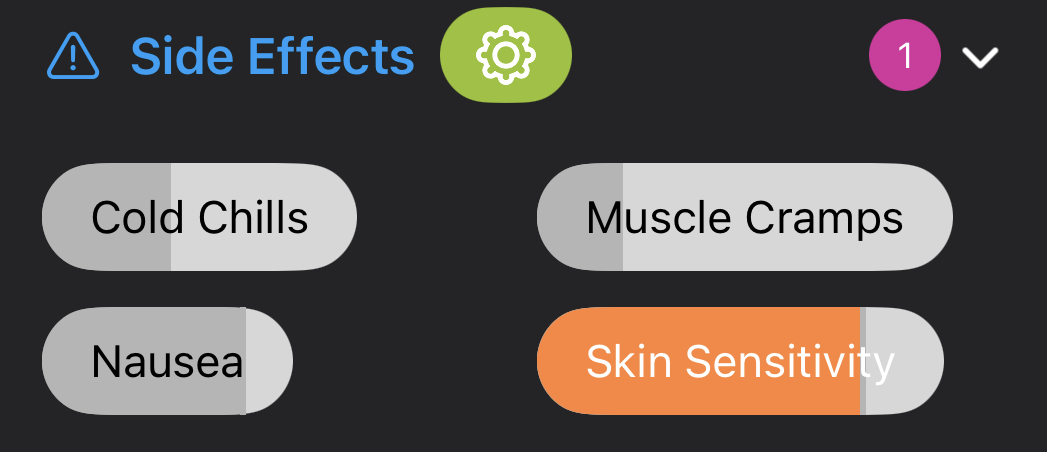
In Pokii, Skin Sensitivity can be one of the side effects in the daily check-in, next to nausea, cold chills, and muscle cramps. After a few weeks you can look back and see whether it follows your doses.
When to talk to your prescriber
Bring it up even if it's mild, and say the word "dysesthesia" if it helps. It's in the label, so it's a legitimate thing to raise. In the research, some people with severe symptoms needed a dose reduction or stopped treatment, but the labels don't give a rule for this. Whether to wait it out, slow your dose increases, or change your dose is a decision for you and your prescriber, not something to change on your own.
Get checked promptly if the skin symptoms come with a rash, blisters, swelling, fever, numbness or weakness, or if they're severe enough to interfere with sleep or daily life. Those aren't things to assume are the medication.
The short version
Skin sensitivity on a GLP-1 is a real, labeled side effect: tender, sore, burning, or tingling skin that often starts during dose increases and tends to go away if the medication stops. It's uncommon in trials, and clearly more common at higher doses. If your doctor hasn't heard of it, the prescribing information has.
I built Pokii to track exactly this kind of thing: shots, side effects, appetite, and weight on one timeline, so you can show what's happening instead of trying to describe it.
This article is for general information and isn't medical advice. Talk to your prescriber about dosing, side effects, and changes to your treatment.